Cello repair -
Posted on | September 13, 2009 | 1 Comment|
The cello side shown below is from an 18th Century German cello made in Mittenwald by a member of the Klotz family. The ribs over the years had been cracked in various places and had some wood worm damage as well.
It was brought into the workshop for restoration.
We used a variety of techniques to reinforce the many cracks in the ribs. In the example above, a crack in the rib ran right next to the spruce lining inside. To avoid removing, or cutting the original wood my assistant fitted 3 spruce studs inside going from the rib over the lining to reinforce the crack. So no original wood was lost or disturbed and the crack is held closed.
The end of the studs are cut at an angle in an effort to avoid future cracks.
Workshop in Ottawa
Posted on | September 2, 2009 | 1 Comment|
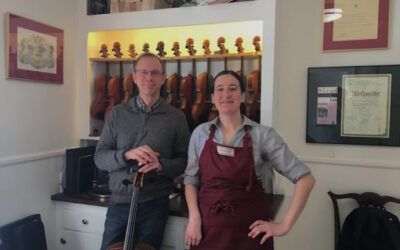
This is one of the rooms in the new workshop. These workbenches are used for making instruments. I have another room for restoration work further down the hall. By the entrance I have an office with my library and space to try instruments.
At the moment I’m making another copy of a Del Gesu violin, which is on the left hand bench. Above on the shelves are varnish materials and various tools. My laptop sits on the bench with some recording equipment and UV light mounted underneath.
On the right side is a taller bench with the sides for a cello.
The view from my window looks onto St. Anthony Church and down Gladstone Avenue.

Our violin shop has moved to 792 Gladstone Ave.
Posted on | July 26, 2009 | 2 Comments|
We are pleased announce our new workshop in Ottawa’s little Italy opening on August 1. Visit the new convenient location at 792 Gladstone Avenue, next door to the beautiful St. Anthony’s church, just east of Booth Street.
We are having an open house:
When: Saturday, August 1st from 10:00 to 4:00.
Where: 792 Gladstone Avenue, Ottawa
Enjoy some treats from little Italy and see our making and restoration workshop.
Services:
We continue to make fine concert instruments. Our recently made violin, a copy of Guarneri Del Gesu used by Yehudi Menuhin was sold to a young violinist who is now studying in London, England.
We also offer the following:
-Restoration and sound optimization on instruments.
-Fine antique instruments - such as Joseph Hel, Lille, France,1892.
-Antique and contempory bows from France, England, Germany, Canada, Brazil and United States.
-Bow rehairing
-A complete range of strings
-Quality cases by Musifia and Bam.
We look forward to seeing you at our new location
For more information visit: http://www.guyharrison.com
Cellos in Ottawa
Posted on | June 29, 2009 | 1 Comment|
On my centre bench is a new cello with a poplar back that’s almost complete. I am now giving the varnish a final polish and setting up the instrument.
In the foreground is the beginning of another cello. The back, sides and neck will be made from maple. In the photo the two centre ribs are bent and attached around the form.
The design used for both cellos is based around an Antonio Stradivari cello from 1701. It will be interesting to hear the difference between the maple and poplar, both of which Stradivari also used.
Visit http://www.guyharrison.com
Violin donated to Uni. of Ottawa.
Posted on | May 25, 2009 | No Comments|
.
.
.
.
.
.
.
.
.
The violin above was recently donated to the University of Ottawa, Music Facutly. It is labeled Elophen Poirson, Lyon and dated 1910. Along with the violin, 4 bows made by the late Ottawa luthier, Joseph Kun were given as well.
The violin hadn’t been used for many years and was bought into our shop to be checked over and appraised. We cleaned it, did some minor varnish retouching and now it’s ready to be loaned to a fortunate student at the University. My assistants also rehaired and cleaned the bows.
Visit http://www.guyharrison.com
New Cello - in our Ottawa workshop.
Posted on | April 29, 2009 | 1 Comment|
For available cellos call 613 569 4803 or visit: guyharrison.com
Pictured on the bench is the Stradivari model cello my assistant and I are making. Inside the sides have been reinforced with cloth.
Stradivari reinforced the sides of his cellos with linen cloth. The sides on our cello are made from poplar which Stradivari also used. It’s a softer wood than maple and is sensible to reinforce them as he did. The linen patches are glued in with hide glue and once dry are very strong and light. The fabric I used was fine quality Irish linen.
Now the front is ready to be glued to the sides and then I’ll fit the neck.
Landolfi (Milan 18th C.) violin repair
Posted on | April 14, 2009 | No Comments|
Below is a violin by Carlo Fernando Landolfi from 18th Century Milan. It was brought into the shop for restoration.

c
c
c
c
c
The peg box had been fitted with plastic peg bushings by another violin shop. Traditionally when the peg holes are badly worn, the holes are filled with wood and fresh holes are redrilled. In this case the plastic peg bushing has caused the neck graft and old repairs to come apart. I suspect there was a conflict between the wooden scroll expanding and shrinking with the seasons and the rigid plastic.

An old repair on the side of the peg box had come loose. After discussing with the owner, we decided to redo the old repair to give much needed strength to the pegbox.
c
c
c

The old repair was removed and new wood was fitted in. When fitting the new piece of maple, I avoided removing any more original wood other than what was necessary .
c
c
c
After varnish retouching was complete, new peg holes were reamed for the pegs. The scroll may need a new neck graft, but for the time being it seems stable. The violin is now in use everyday.
Years ago I had photographed this violin before the plastic bushings were done by the violin dealer. It was very useful for the owner and I to be able to compare what had actually broken loose over that time.
Visit http://www.guyharrison.com
The Leading Note Foundation
Posted on | March 30, 2009 | No Comments|
A great music program started recently in Ottawa has been the Leading Note Foundation
The program gives children from low-income communities the opportunity to learn and make music together. Lessons are provided by volunteers. Instruments have been donated by the public and violin shops. We donated a student cello and violin.
Many of the donated instruments and bows needed to be brought into good playing condition. My assistant, together with two other luthiers and a bow maker helped put many of the instruments into working order for the young players.

Charline (right) sets up instruments- September 2008.
For information on this wonderful program and how to help go to The Leading Note Foundation
For more information on our workshop visit http://www.guyharrison.com
.
New neck graft
Posted on | March 15, 2009 | No Comments|
While making a copy of Yehudi Menuhin’s Guarneri Del Gesu violin, my assistant and I have also been making a cello. It’s inspired by the ‘Castlebarco’ 1699 Stradivari cello at the Library of Congress and the ‘Servais’ 1701 Stradivari cello at the Smithsonian. Both are in Washington D.C., which I visited a few years ago.

Our cello back and sides are in poplar wood like a number of Stradivari’s cellos. And the scroll is carved from pearwood, which is a good solid hardwood for the pegs to fit into. Both poplar and pearwood are plain in appearance and match well together.
To have a beautifully figured maple neck, which I personally prefer, I grafted the plain pearwood scroll onto a maple neck- in the same style as the Stradivari cellos.
The method of grafting I used though is new. It’s a technique I heard about at a meeting of the American Federation of Violin & Bow Makers.
The traditional method cuts wood from the front of the peg box to accept the new neck graft. With good varnish retouching this can be made completely invisible- but as the decades pass the joint often begins to appear as an ugly joint line.
The new technique removes nothing away from the front of the peg box and the new neck graft is hidden within the walls of the pegbox and covered beneath the top nut. It will make varnishing around the scroll much easier on our cello. This method would also be useful when fitting the first neck graft to an old instrument, to save as much original wood and varnish as possible.

On right: the maple neck graft is glued into the pearwood scroll. Next the pegbox will be carved out and the scroll finished.
Ottawa Violin teacher and a commission?
Posted on | March 1, 2009 | 1 Comment|
Visit our website at : http://www.guyharrison.com 792 Gladstone Avenue, Ottawa, Ontario K1R 6X9 Tel: 613 569 4803
—————————————————–
This week I had a parent come into the shop. She wanted to know how much she could sell her daughter’s violin for. It was poorly re-varnished, had a replacement front, and badly repaired cracks in the scroll, sides and back.
I said the value was very low. The parent had paid $6000 for the violin, some of which she had borrowed from her parents. When buying this violin she had been recommended by the violin teacher to only visit one particular violin dealer.
In this case I wondered if the teacher had received a “teacher commission” because I couldn’t understand why anyone would recommend this instrument.
For those parents and students who don’t know, some dealers and violin makers offer some string teachers a commission (some might call it a kickback) if a student purchases an instrument from them. The amount is often around 10 to 20% of the sale price. The student is not told about the payment.

What’s sad in the rather typical case above, is the family probably asked for the teacher’s help in the selection process because they wanted an independent opinion. With a secret payment, this valuable objective opinion is lost and the teacher is selling almost in partnership with the violin dealer. The teacher may have been tempted to recommend a more expensive instrument and not the best sounding or recommended buying from the dealer paying the commission rather than other good shops who were not.
If you are a student or a parent of a young player it might be worth asking if your teacher sometimes accepts commissions. If they do, they still might be a wonderful teacher, but you might want to find someone else to help you with your instrument selection.
It’s worth noting, that many generous teachers in Ottawa spend a lot of time helping their students find a good instrument or bow. Parents can pay the teacher directly for this extra time and service which is completely fair and I would encourage this.
In my business I have never paid teachers to recommend my work. Every student who has bought an instrument from me can be confident that no commissions were paid or added to the sale price.
I hope this information is helpful to parents and students when looking to buy an instrument or bow in Ottawa or anywhere else in North America.